


Table of contents:
Sigil Core
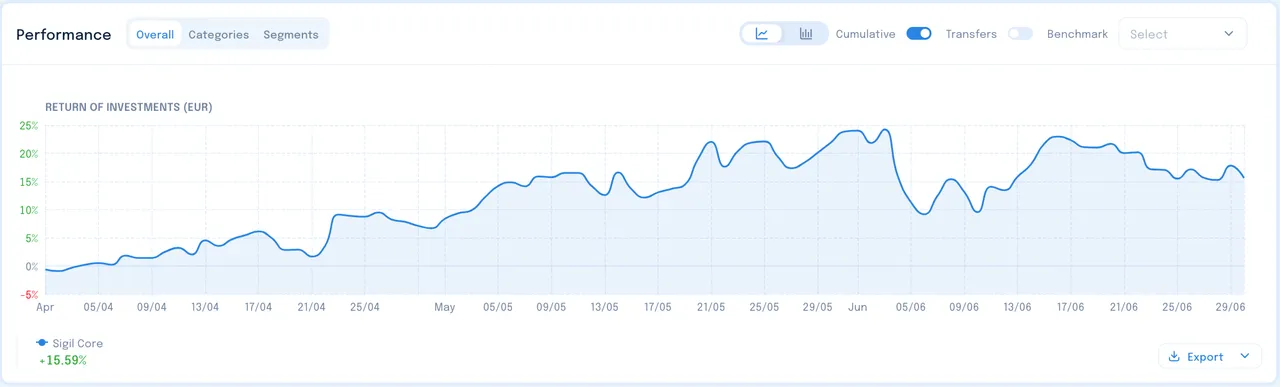
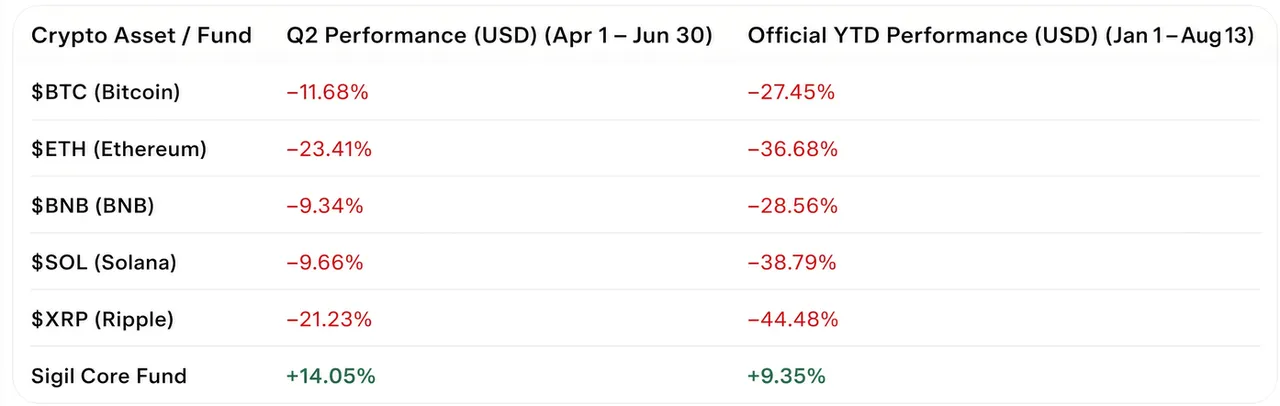
In Q2 2026, Sigil Core returned:
- 15.59% net of fees against EUR
- 14.05% net of fees against USD
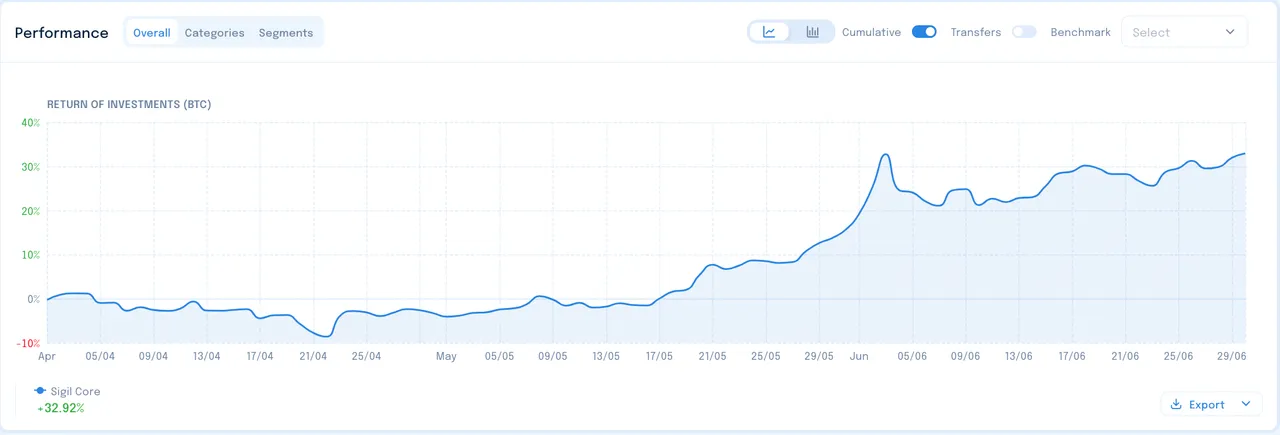
…and outperformed its BTC benchmark by 32.92% net of fees:
Dear investors and friends,
We had a great quarter both in terms of fiat and BTC benchmarks. Sigil Core's outperformance this quarter was driven primarily by our large positions in perpetual exchanges — HYPE and LIT above all. On the other hand, the broader crypto market remains challenging. Bitcoin traded almost entirely on MicroStrategy's financial condition, as markets weighed their positioning against pending dividend obligations. Adding to the pressure, DeFi protocols suffered a string of successful hacks and social engineering exploits.
DeFi in tough spot
A disclaimer first: Sigil Core lost no money in any of the events described below. As we are structurally long crypto, our PnL was affected only by the market volatility that followed.
The most consequential was the $292M KelpDAO hack. On April 18, attackers exploited a misconfigured LayerZero cross-chain verification setup to mint unbacked rsETH, then pledged the stolen tokens as collateral to borrow from other protocols, Aave chief among them, triggering a liquidity crunch. Part of the funds was frozen and recovered with Arbitrum's help, and the DeFi community organised emergency donations to plug the hole in Aave and head off a liquidation cascade. Catastrophe was averted, but the episode exposed a hidden fragility in DeFi. Until then, the standing advice was "Just use Aave", a shorthand for a battle-tested protocol you could use without a second thought. That aura of invincibility is gone, and the ecosystem now finds itself in an uncomfortable position: in many cases the yields on offer don't justify the risks.
The other headline event was the exploit of Drift Protocol, at a $285M loss. This was not a code-level attack but sophisticated social engineering: the attackers cultivated a business relationship with the Drift team over several months, gradually compromising the devices of key employees.
Beyond these two, April brought a series of smaller exploits that reverberated through the crypto world. The main actor behind them is Lazarus, the North Korean state-backed hacking group. The common narrative attributes these hacks to new AI capabilities which make it much easier to find bugs in the code. That's partially true, but incomplete. Several of these attacks were months-in-the-making operations combining social engineering with technical work, executed by well-funded and highly skilled teams. What is true is that AI is reshaping cybersecurity broadly, and older DeFi protocols with stale TVL now stand out as soft targets.
In the last letter we presented our "winners gonna win" take — saying that existing crypto players already have a durable lead and moat, and won't be easily disrupted by newcomers. In light of recent events, we must reconsider this opinion. DeFi ecosystem suffers from complacency and inertia, technical and inferior security practices. The first generation of DeFi was built under the banner of "move fast and break things”. Being first to market and growth were prioritised over security. In the future, DeFi builders will need to slow down, focus on formal verifiability, and treat their projects as mission-critical financial infrastructure, rather than scrappy experiments from a garage startup.
For now, the threat of hacks and exploits remains elevated, and we are proceeding cautiously in our DeFi activities. Long term, however, this environment applies evolutionary pressure: the strong survive, the weak are culled. Put less dramatically — DeFi isn't dying, it's being forced to transform and improve.
Security, however, is only half the equation. Even the most secure protocol matters little without compelling products behind it. The circular, crypto-native yield and products will no longer be enough to grow the market. We believe the next generation of DeFi must attract new use cases.
Projects such as USDAI are a good example, tapping into DeFi liquidity and infrastructure to finance the AI data centre build-out at the edges, where rigid traditional credit providers fail to accommodate these businesses (mostly due to the specifics of using hardware as collateral). Disclaimer: Sigil Core is an active participant in USDAI's offering and holds directional exposure in $CHIP, the USDAI token.
Nvidia twee
Open tweet
Over the long horizon, our thesis is unchanged: DeFi is the next evolutionary step of fintech. That conviction has already paid off. One segment in particular, the perpetual DEXes, has been a cornerstone of DeFi adoption and Sigil’s outstanding performance.
Hyperliquid and Lighter
Perpetual DEXes continue to dominate the shifting crypto landscape. While early perp DEX volume was overwhelmingly crypto-native, an increasing share now flows into "Real World Assets" (RWAs) - a clumsy industry term for any asset that originates off-chain and is brought on-chain through various mechanisms. On Hyperliquid, the bulk of this volume is converging around stock perpetuals led by retail favourites among AI names (such as SK Hynix) and pre-IPO markets (such as SpaceX just recently).
As noted in the previous letter, we consider Lighter one of the very few credible challengers to Hyperliquid in the perp DEX arena. It was a contrarian call at the time, and our LIT position moved against us for a while before the market finally came around and gave it some recognition.
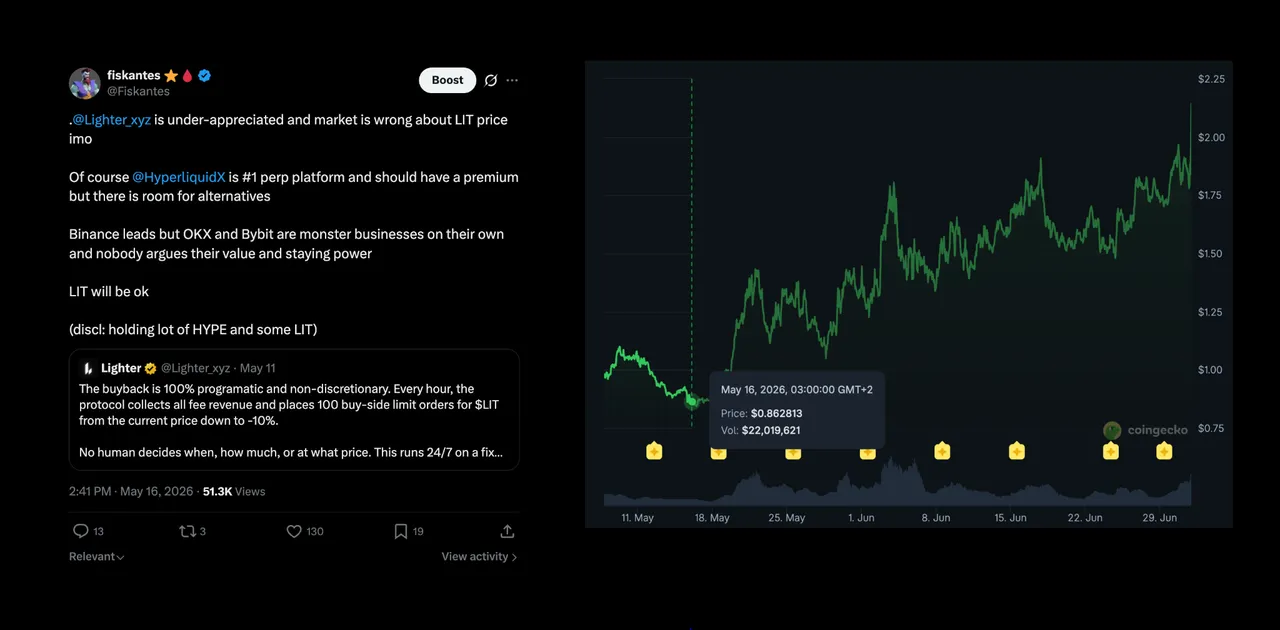
Both positions remain in the book at significant size. We view the "perp-ification of finance" as a secular trend spanning multiple cycles. Though we did take the opportunity to trim part of our HYPE exposure in the 60s. (as of writing price is around $57).
Saylor in a tough spot
MicroStrategy re-focused heavily on their new product, STRC. STRC is a special class of shares with a dividend that's supposed to behave like a pseudo-yield instrument backed by Bitcoin. While initially popular, it fell out of favor in June, when the STRC price decoupled from its "par" of 100 all the way down to 74.
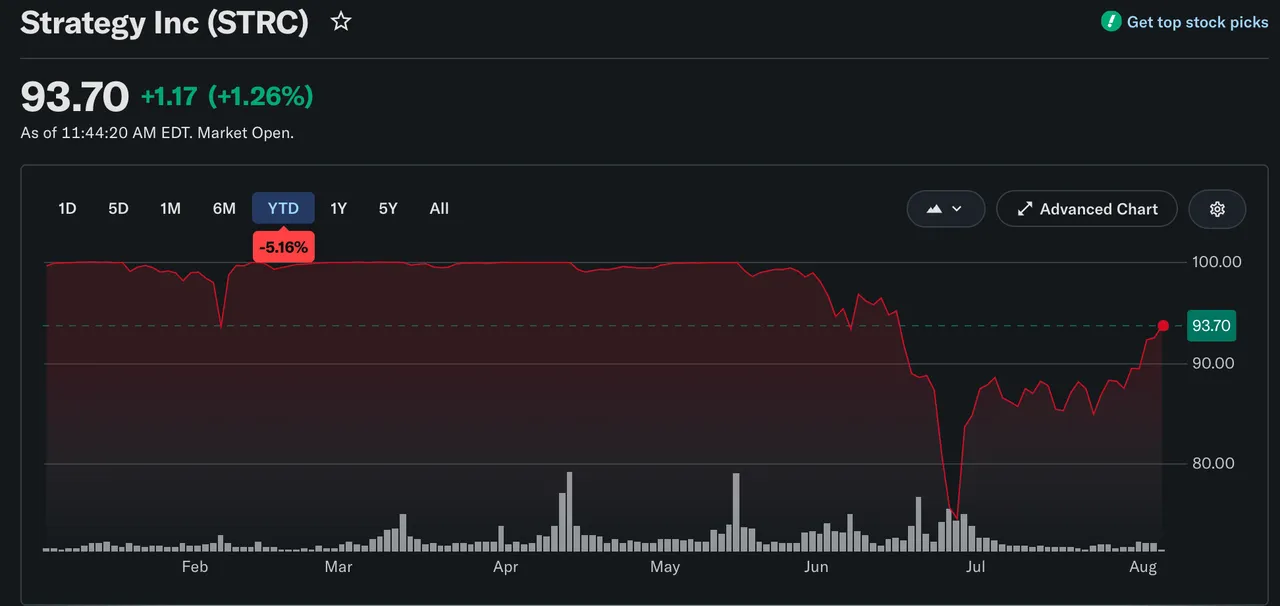
In order to placate the nervous market and create a cash reserve for future dividends, Saylor decided to sell some of BTC reserves. It's worth noting that MicroStrategy was one of the biggest structural buyers of BTC over the last 3 years, and in our opinion, this is the major reason for Bitcoin's relative outperformance in 2024 and 2025. Thus, MicroStrategy turning into a structural seller is somewhat bearish for BTC (reflexivity cuts both ways). It's also worth noting that Saylor's average sell price ($64k per BTC) is below his average buy price ($75k per BTC). Cynics would say these actions are effectively turning MicroStrategy into a poorly managed Bitcoin-timing hedge fund.
On the other hand, MicroStrategy has managed to build a decent cash reserve and will be able to pay dividends and remain flexible for the foreseeable future. The risk of a MicroStrategy death spiral with current cash reserves is thus very low.
Bitcoin's continued dominance
Bitcoin still dominates the crypto asset market, despite its stagnating transaction count.
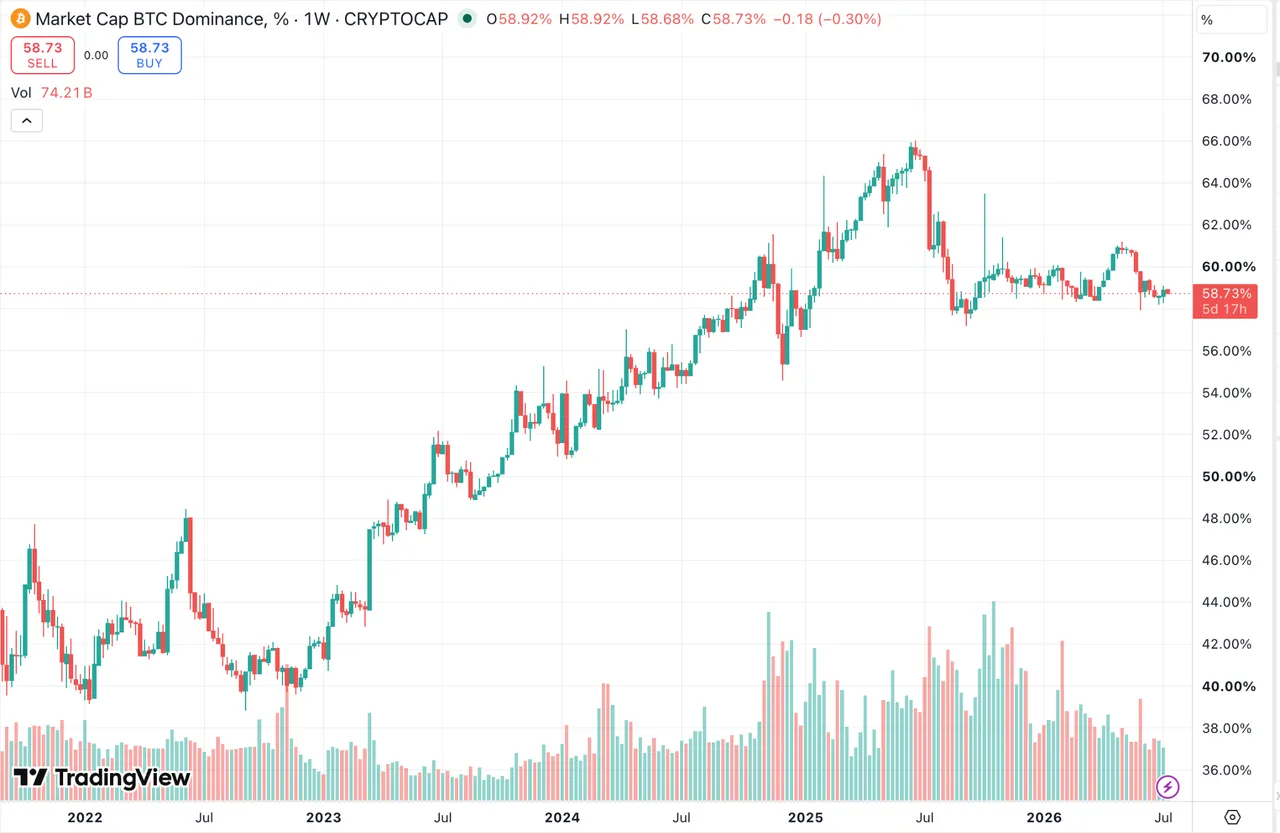
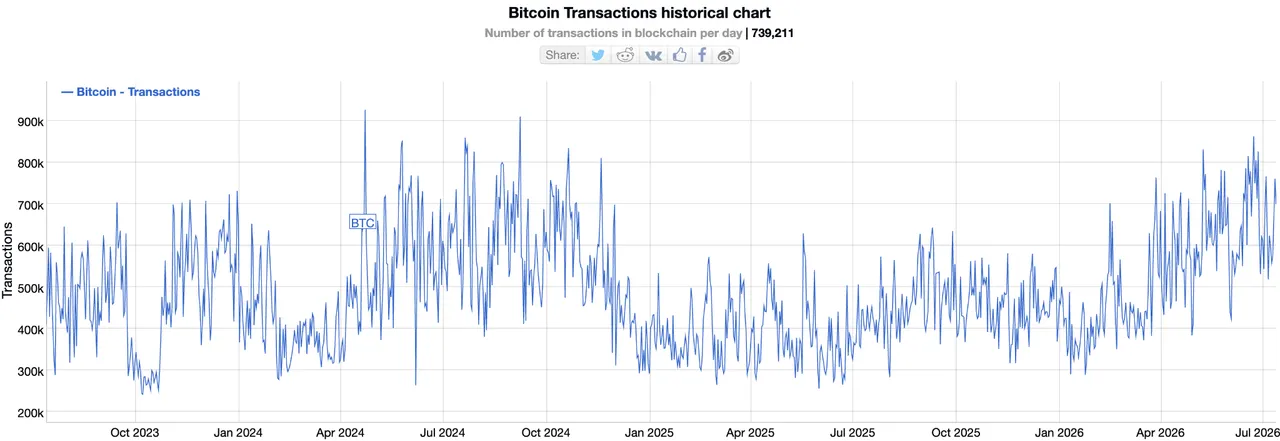
On paper, plenty of blockchains are more useful. They offer fast and cheap payments, permissionless smart contracts, asset exchange, tokenisation. So why does Bitcoin, with negligible payment utility and basically zero programmability, still commands more than half of the total crypto market cap?
The market's answer is unambiguous: Bitcoin is valued not as a payment protocol but as a digital store of value: an alternative, non-sovereign asset. Its target is the gold market and broadly the store of value market, not banks, Visa, or Mastercard. Those are being disrupted by a different piece of blockchain technology: stablecoins.
Bitcoin remains basically in a category of its own within the crypto landscape, with very few contenders.
Enter Zcash
Technically, Zcash is the closest thing to Bitcoin in crypto, while offering enough differences to avoid being a copycat. It is the first practical implementation of a decade of research in zero-knowledge cryptography. Its shielded pools offer strong, opt-in privacy: shielded ZEC is fully private, unshielded ZEC fully transparent, like the BTC ledger. And unlike Bitcoin, Zcash has a credible roadmap to post-quantum cryptography and on-chain scaling today.
Ideologically, Zcash also resembles Bitcoin, or rather its early ethos, aiming to empower the individual against an over-reach of authorities and powers that be. While crypto's purpose is nowadays too often reduced to a "more efficient fintech backend” and Bitcoin is being package as just another financial product, Zcash stands out as one of the few remaining pillars of the old school cypherpunk vision.
This becomes more important today. AI dramatically expands the surveillance toolkit just as geopolitical and economic pressures raise the incentives to abuse these newfound powers.
We called the return of privacy as a theme earlier, and we continue to look for the best opportunities to express this thesis. Zcash ($ZEC) is currently one of the larger positions in our long portfolio.
That being said, strong privacy in shielded pools comes with trade-offs. One of the sacred features of Bitcoin is the immutability of its supply - a strong guarantee that no single party can exploitatively mint new coins outside the bounds of the protocol. If such an exploit were to happen, the public nature of the Bitcoin blockchain would immediately set off alarm bells. In Zcash's shielded pools, the same exploit could go undetected: we would only learn of it once too many coins spilled back into the transparent part of the protocol.
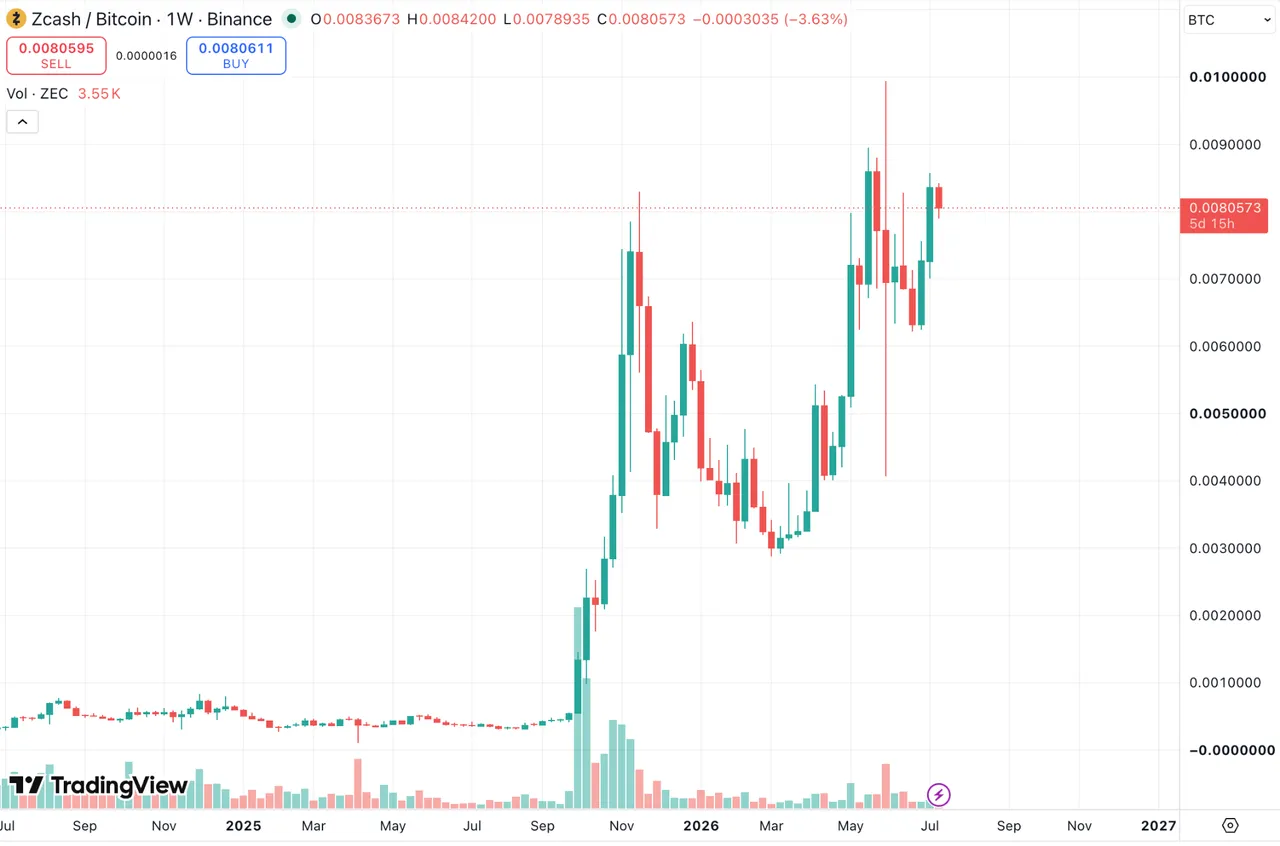
This exact risk rattled the Zcash community in May: a hired white-hat researcher found a potentially exploitable bug in the dominant shielded pool. Leadership responded proactively and delivered a credible fix in record time. But the market panicked anyway, and ZEC dropped as much as 50% in a single day.
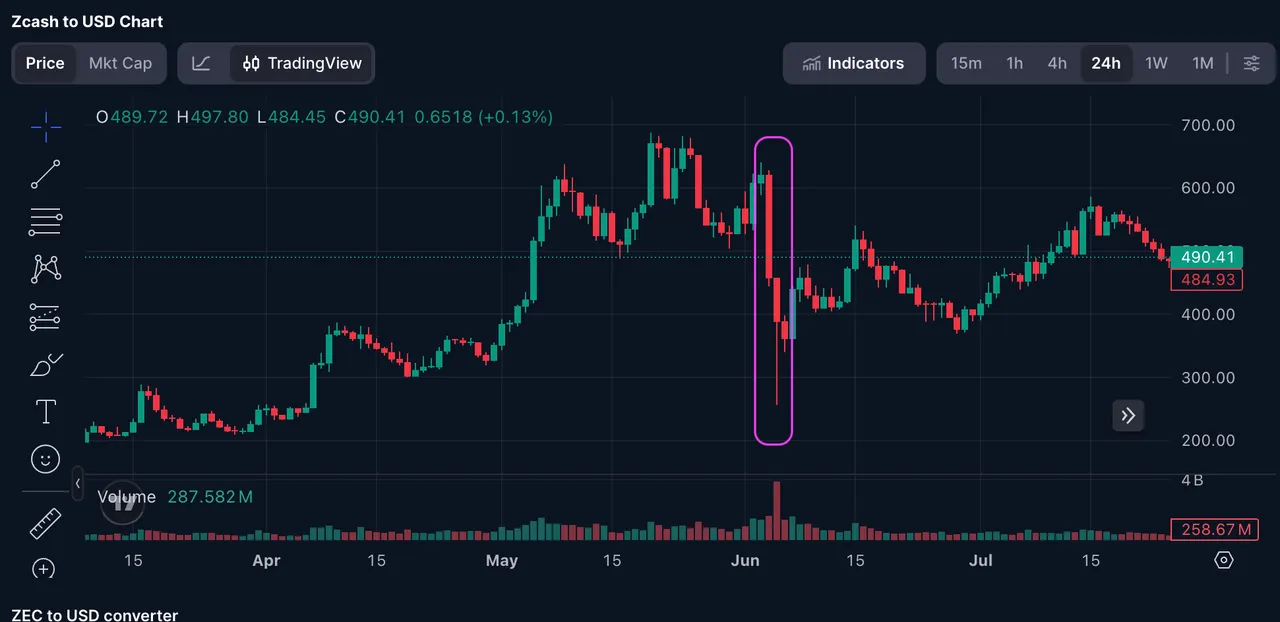
Our research team assessed the situation immediately and concluded the fear was overblown — the exploit was unlikely to ever materialize. Despite the sharp mark-to-market drawdown, we held the full position, and once more concrete upgrade plans validated our read, we added to it. (Detailed explanation here.)
With the dust settled, the market now prices exploit risk as minimal — and the episode strengthened our confidence enough to re-underwrite the thesis. Several upcoming tech upgrades should make ZEC even more competitive: not as a Bitcoin replacement, but as its complement and a viable alternative. Meanwhile, many ideologically driven BTC holders feel alienated by Bitcoin's institutionalization and "trumpification," narrative increasingly dominated by Saylor and a quantum-risk debate that has stalled in the bitcoin community while Zcash already has a roadmap to solve it. Even a partial rotation of that cohort into ZEC would drive further relative repricing.
What's coming next
We are reluctant to commit to any particular crypto cycle theory. Yet the cyclicality is hard to deny in retrospect: the pattern has rhymed almost uncannily for as long as we've been active in these markets. Through that lens, the last bull market popped in late 2025, and we have been in a bear market since.
In our Q1 letter we noted that prices seemed to have found a comfortable bottom. The events of Q2 tested that claim by fire. Despite a steady drip of bad news (DeFi exploits, Saylor selling BTC, the Zcash drama), crypto markets were more in a slow bleed mode rather than in a panic. When bad news no longer pushes prices meaningfully lower, most of the sellers sensitive to it are usually already out. Now, that doesn't necessarily mean a fast recovery is likely. The quiet "boring" period often persists for some time until positive catalysts retake the narrative. The signs of recovery we are following (renewed on-chain activity and slow and steady institutional adoption) are hard to quantify. On the other hand, the point about continuous unlock pressure for many tokens raised in our Q1 letter stands as well.
Zooming out from cycles, crypto's overarching question has always been: "Where will the next 100M users come from?" Every past wave of adoption came directly from end users: idealists, darknet and gray markets, technologists, speculators, prediction-market bettors, stablecoin yield seekers. Financial products, retail users. That's why many of us, ourselves included, reasoned about crypto as a consumer market akin to internet media. And frankly, it often looked like a strange entertainment industry: colorful niche celebrities, wild events, and inventive new apps to win and lose money on.
But at its core, crypto is financial technology. So perhaps the better question for the next five years is: "Where will the next $1T come from?" Probably not from 100M retail users individually installing wallets and venturing into on-chain DeFi. New retail products will definitely keep emerging on the margins, but we think that the next major wave of adoption will likely be driven by financial institutions and tech companies.
The obvious counterpoint: "Institutions are coming" is one of crypto's oldest refrains, and until now it has mostly fallen short. While suits ran pilot programs and talked big on conferences, the bulk of real on-chain adoption kept arriving bottom-up, from retail users and speculators.
If we claim this time is different, we should bring the sauce. The shift from the past is twofold:
Infrastructure: Even two years ago, something like an institutional-grade, scalable blockchain wasn't really a thing in practice. Sure, Solana was already live, but it suffered from outages, and its tech stack had many gaps. In 2026 the situation is materially different. The infrastructure our industry spent years and billions of dollars on is finally ready to take on the TradFi requirements head on.
Regulation: Until Trump's presidency, crypto was seen as an adversarial technology by the establishment. The current American administration, for all its flaws, is kicking this Overton window wide open, changing the regulatory landscape and encouraging institutions to experiment with crypto. ETFs and other TradFi friendly packages that make crypto assets touchable for regulated players are also becoming commonplace.
What we are watching in Q3
- Clarity Act — the key piece of pending crypto regulation; prediction markets put its odds of passing this year at roughly a coin flip.
- Zcash Ironwood upgrade — covered above (disclaimer: Sigil is long ZEC).
- Solana network upgrade — lower latency, better usability, and a stronger grip on on-chain spot volume (disclaimer: Sigil is long SOL).
- Circle's Arc launch — a payments-first blockchain (disclaimer: Sigil is long CRCL).
- Robinhood Chain — an EVM-based L2 in the mould of Base, designed to bring Robinhood's tokenized stocks, yield products, and retail user base on-chain (disclaimer: Sigil is long HOOD).
- LayerZero's ZERO launch — a new institution-first network built with financial heavy-hitters. ZRO is hated and oversold after the exploit discussed above, but all signs point to a mainnet launch this autumn (disclaimer: Sigil is long ZRO into the event — our most contrarian position on this list).
As always, we are honored to have you on board and will keep working to deliver outstanding results.
Sigil Stable
In Q2 2026, Sigil Stable returned +1.63% net yield against USD (2.99% against EUR), with a Sharpe ratio of 2.52.
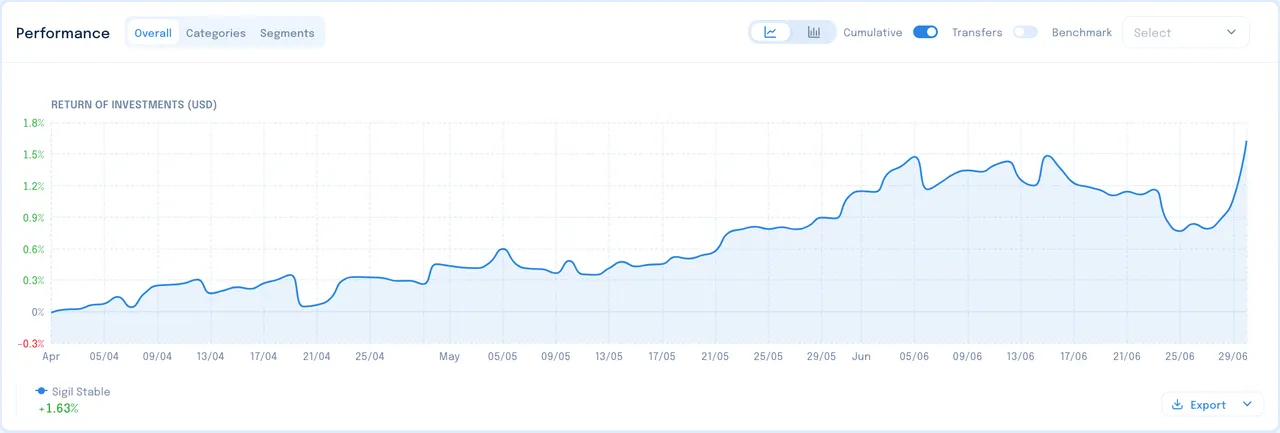
Q2 was one of the more “interesting” quarters we have had in Sigil Stable. The boring market-neutral crypto is becoming harder due to exploits. Fortunately, we managed to navigate the space without any loss of capital.
One of the reasons is our aggressive portfolio evolution. When we launched Sigil Stable over 5 years ago, almost 100% of the portfolio sat in public DeFi opportunities, the risk reward ratio made sense back then. But the space has matured, and to stay agile, we had to adapt. By the end of Q2, more than 70% of our portfolio was allocated across three different segments within our "private" bucket, with a portion of that operating completely off-chain.
SPCX: the largest (pre)-IPO in history
For years, crypto folks liked to claim that open, 24/7 markets are the ultimate venues for price discovery. Following up on our Q1 letter; crude oil, gold, silver and S&P 500 contracts on Hyperliquid's HIP-3 markets are great real world examples. SpaceX pre-IPO market might be the best validation so far.
Pre-IPO markets historically operated behind velvet ropes: private brokers, long settlement cycles, qualified-buyer restrictions, information asymmetry, and very wide bid-ask spreads. Three weeks before the SpaceX IPO, Trade.xyz turned the same event into a liquid, transparent, 24/7, collateralized perp market on Hyperliquid. It did $33 million of volume on day one. Within hours, speculative demand had pushed it to $216, implying about $2.5 trillion. Binance followed roughly three days later with its first pre-IPO perpetual product,
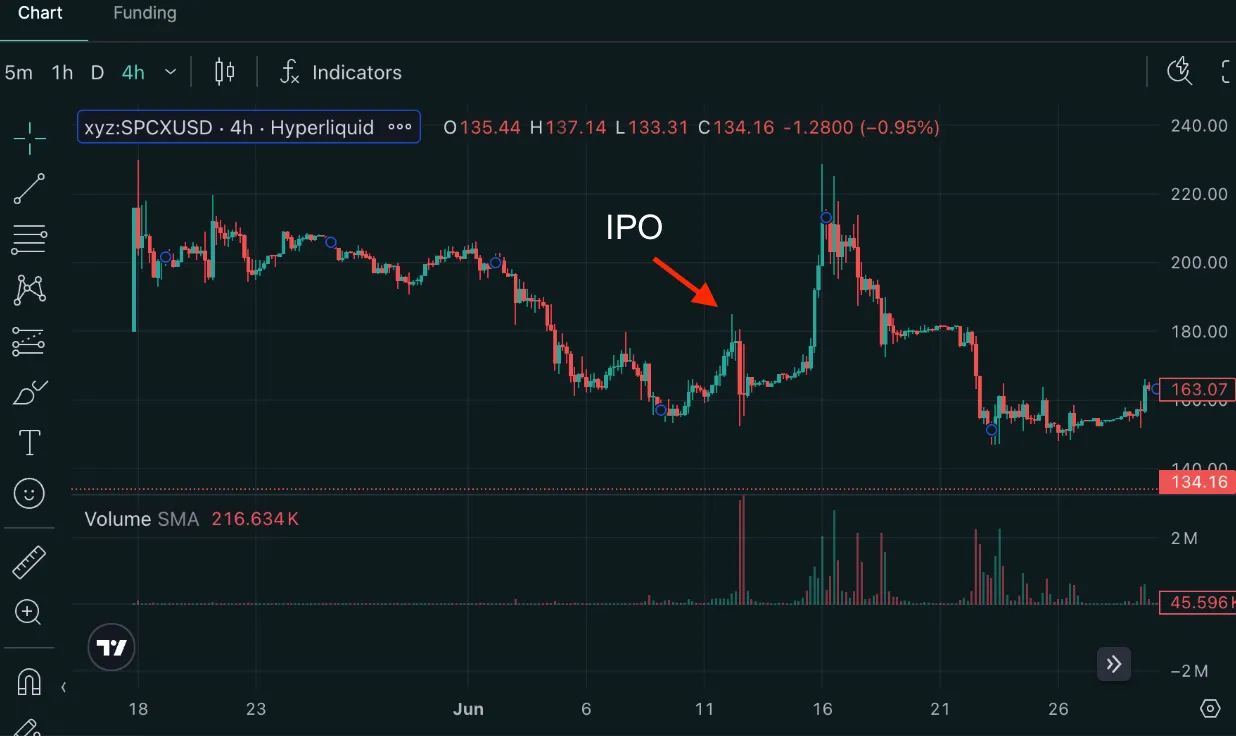
Every RWA perp we discussed in our previous letter has the same structural weakness: the contract is a derivative of an external price feed, and when that feed freezes or lies, the contract breaks. Pre-IPO perps face a completely different issue. There is no external price. SpaceX had no public market until June 12. Trade.xyz's answer was to derive the mark price entirely from its own internal order book. Binance took a more conventional route, creating an index referencing private market valuation signals and share count data. Both approaches carry complex trade-offs that warrant a separate deep dive.
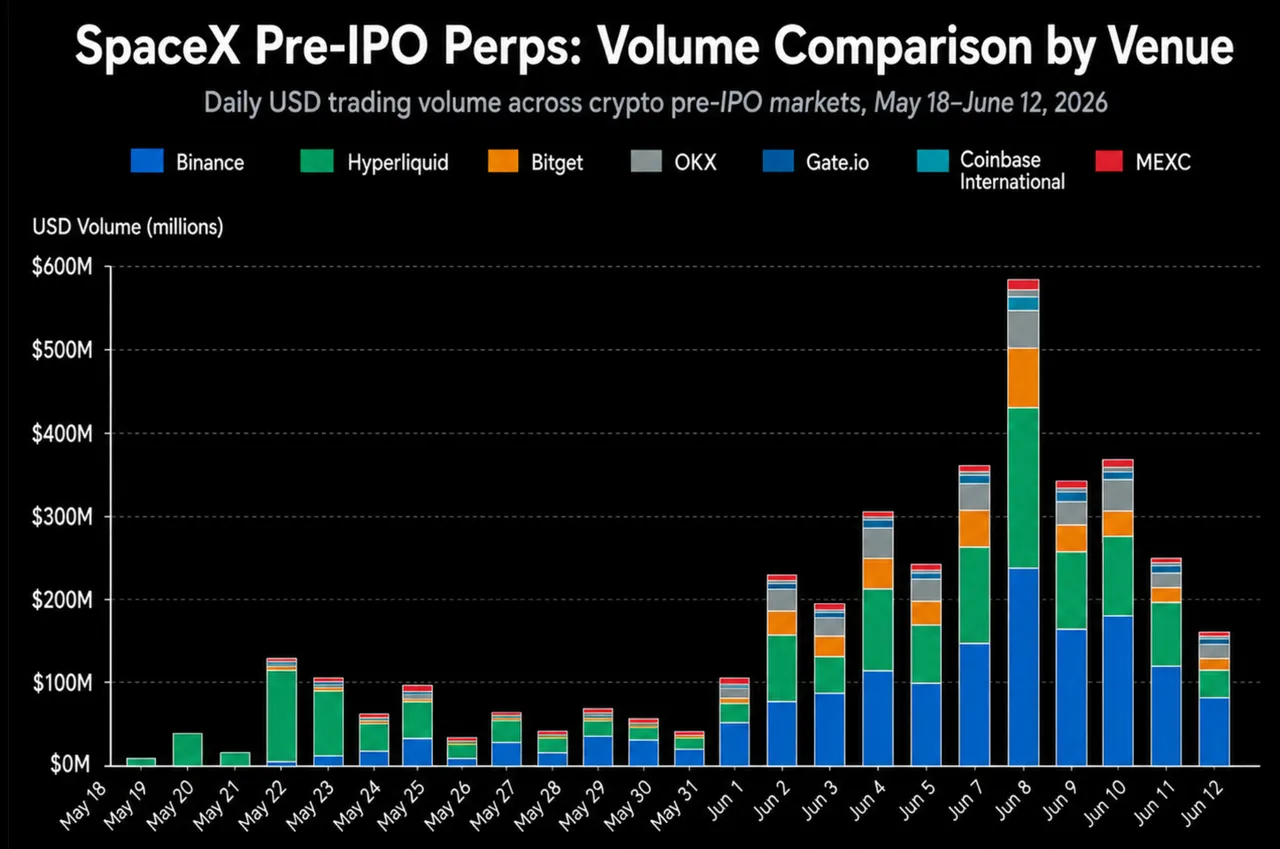
When it comes to volume, Hyperliquid won the early rounds, while Binance took the lead in early June, (SpaceX perps became Binance's second-largest product by volume, trailing only BTC, behind only BTC.) Cumulative volume across all venues surged past $3.5 billion.
The pre-IPO market's aggregate VWAP into the event was $155 against a $135 IPO price. That’s a 15% premium to the deal, but roughly 4% below where the stock actually closed on day one. Crypto perps priced the largest IPO in history more accurately than the underwriters did. Let that sink in (couldn’t resist to include this Elon's famous pun).
Sigil Stable actively traded SPCX across three different pre-IPO venues. Through our partners, we also secured a traditional IPO allocation, exiting the trade with significant profits that far outpaced our standard delta-neutral strategies.
Saylor's “Infinite Money Glitch” gets a reality check
Let me expand on Fiskantes’ "Saylor in a tough spot" section and address the elephant in the room.
Michael Saylor had a great flywheel spinning with Strategy's STRC perpetual preferred shares from Feb through May. At the time, they were paying a fixed $11 annual dividend per share (an 11% yield at par). The mechanic was brilliant in its simplicity: when STRC trades at or above its $100 par value, issue more shares, take the fresh cash, and buy Bitcoin. This pushes the BTC price higher, boosting the BTC-per-share metric for MSTR common stock. Ideally, MSTR appreciates faster than BTC, allowing him to issue more common shares to raise even more cash. The beefed-up financial metrics boost counterparty confidence, allowing him to rinse and repeat, raising cash via STRC just before the monthly dividend snapshot.
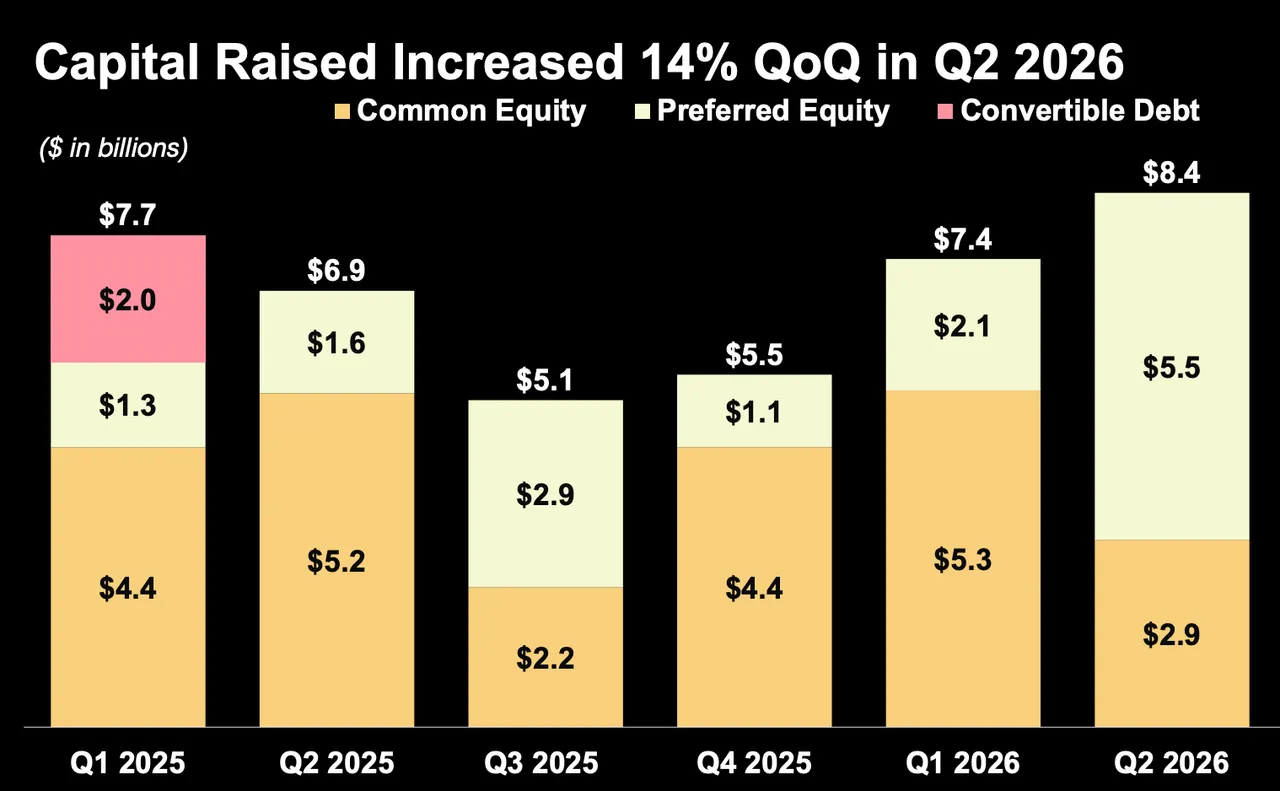
The problem with a hyper-leveraged positive feedback loop is that the slightest friction can throw it into reverse. That friction came via two distinct unforced errors by Saylor:
- He used the cash raised from STRC to retire $1.5 billion in principal of Strategy's 0% convertible notes due in 2029, which drastically drained his cash reserves.
- He sold 32 BTC. While a drop in the ocean compared to the capital raised, it was a signalling disaster. It told the market the buyer of last resort might be switching sides.
Enter the negative feedback loop. Shrinking cash reserves created panic among STRC holders. Because the STRC supply had ballooned exponentially since February '26, defending the $100 par value became fundamentally harder. Once STRC drops below $100, the money printer stops and no new cash can be raised. The market quickly priced in the reality that Saylor’s buying sprees were paused, and worse, that he might be forced to sell more BTC due to that initial 32-coin "test" sale.
Because MSTR trades reflexively, the common stock started bleeding faster than Bitcoin. Once the mNAV dipped below 1, issuing more MSTR to raise cash became mathematically irrational. At that point, Saylor's only option to service the dividends on STRC and other perpetual preferred would be to sell more BTC, pushing the underlying asset even lower. If BTC goes significantly lower or simply stagnates for a few years, Strategy faces insolvency.
Strategy managed to maneuver out of this chaos. They raised just enough cash via MSTR sales right before the mNAV broke 1. The risk of the death spiral has been significantly mitigated.
Sigil Stable held a low single-digit exposure in STRC during the June turmoil. Had it not been for this position, our profit for the month would have more than doubled, pushing us past 15% annualized after fees. We have since aggressively slashed our exposure, most recently exiting the bulk of it last week above $94. We currently hold less than a 1% allocation.
Conclusion
Q2 confirmed the direction of travel for Sigil Stable. The lazy part of stablecoin yield is compressing. The interesting part is expanding.
We are watching the pre-IPO markets closely into Q3. OpenAI and Anthropic contracts are now live across Binance, Coinbase and other venues. The biggest Chinese IPO in history just had its price discovery run through the pre-IPO market on trade.xyz. This trend will only accelerate from here.
On the private side, we entered into two new liquidity deals with our partners and will be scaling our allocation in Q3. Furthermore, the incentive rewards from several of our 2025 allocations have begun vesting and will continue through the rest of the year.
Thank you for your ongoing trust in Sigil Stable.
Supernova Launch
We have successfully launched our new vehicle - Sigil Supernova. It’s a hybrid public/private vehicle which aims to invest in the most promising frontier technologies on the private side and capitalize on the most impactful trends and situations on the public side. While we do have a forward looking thesis (you can read it here), this thesis will evolve over time. In other words, Supernova contains everything that’s not crypto that we want to invest in or bet on (with long and frontier tech bias).
We want to emphasise this is not us pivoting away from crypto. Our two crypto funds - Sigil Core and Sigil Stable, remain our flagship products where our domain expertise is the strongest. But we also believe as crypto itself will slowly merge with the rest of the market and become an inseparable financial stack, we will also benefit from expanding our horizon.
Traditional markets are currently distorted by massive AI CAPEX and hardware bubbles. We are aware of the challenges that come with this timing. We plan to take off slowly and avoid “buying the top”. Fortunately we still see plenty of opportunities that are currently not priced for perfection, both on the public and private side.
One of the significant aspects of Sigil Supernova for us as managers - is that it allows us to keep the vast majority of our net worth invested via Sigil fund and thus be aligned with you, our investors. It would make no sense to omit opportunities and trends outside of crypto (AI proliferation, space exploration, robotics, biotech and more) from our personal portfolios. Adding Sigil Supernova as a new vertical of our fund umbrella completes the picture of us and underlines our intention to manage our (and your) capital in Sigil fund for decades to come as we now see Sigil as something like our own Berkshire Hathaway.
It also gives you a new option to bet on Sigil's ability to identify new trends and their winners and bet on them.
Thanks for your ongoing trust in Sigil fund. We're glad you´re with us on the crypto journey and now also the general tech journey.